Category Archives: Science Experiments and Explorations
Simple Light Refraction Experiment
Scared of science? Don’t be. Doing science with your kids can be the best part of their week. And it’s not nearly as complicated as scientists and the writers of textbooks would like you to believe. Take, for example, optics. … Continue reading
Beginning Bee Keeping
We started a new family hobby. We decided to start beekeeping as a way to learn and enjoy our new bee pets and also get fresh honey for our family. They also do wonders for flowers, fruits, and vegetables. I’m … Continue reading
Optical Illusions
The eye is made up of two different types of light receptors called cones and rods. Cones are necessary for color vision and to see well in bright light. Rods are necessary for seeing in low light. The two experiments … Continue reading
DNA Extractions
Nathan extracted DNA from peas this past week. The stringy, white, snot-like stuff is the DNA. The DNA looks remarkably like . . . snot. That would be because both DNA and snot are made of similar proteins. It’s a … Continue reading
Dichotomous Key
To help in identifying objects like rocks, plants, animals, sea shells or other stuff, knowledgeable people create dichotomous keys. When using these keys you answer questions about the object always beginning with number one and following the directions as you … Continue reading
Planet Ornaments
Every year my kids and I make ornaments. They love making the glass ball ornaments that you swish paint and rubbing alcohol into for a marbled look. This year they got the brilliant plan in their noggins to create the … Continue reading
NORAD Tracks Santa
Every Christmas we check out the NORAD site. They’ve got stuff about Santa up there already. They keep track of how he’s coming with toy production, how the reindeer and the elves are doing and so on. They have a … Continue reading
Bird Call Craft
CJ made this awesome bird call for cub scouts and we wanted to share it here. You just need a 2x1x1inch piece of hardwood and a round screw eye. Drill a hole in the end of the hardwood slightly smaller … Continue reading
Tracking the Weather
Keeping an eye on the weather on a daily basis helps your kids learn and remember better than learning it once. Besides, kids LOVE setting up their own weather station and playing weather man. Here is a chart to keep … Continue reading
Super Simple Wind Vane
We made these easy wind vanes for school this week. You need: straw straight pin pencil with an eraser index card celophane tape First cut a triangle to serve as the arrow head and a tail. The tail is just … Continue reading
Growing Crystals
We’ve been growing crystals. The kids couldn’t believe how fast their dissolved Borax particulates reformed as crystals. They were done overnight. We examined the crystals with magnifying glasses so they could see the specific shapes formed. The crazy kids in … Continue reading
The Water Cycle
The water cycle is a great jumping off point for a unit study on weather, oceans, cycles, water, conservation, or pollution. We’ve been studying the weather lately, and this week we took a look at the water cycle. I … Continue reading
Recycled Regatta Boat
CJ built a “recycled” boat for his cub scout Rain Gutter Regatta last week. In case you’re not familiar with the famed Rain Gutter Regatta, the kids build boats, usually from cub scout supplied kits, and race them down water-filled … Continue reading
Sunshine City
Normally we don’t share super formal lesson plans on Layers of Learning, but when the Lego Company asked for lesson plans about renewable energy for their LegoSmart contest last year, we were happy to submit ours! Here’s the complete lesson … Continue reading
The Chemistry of Blood
Our bodies are chemical factories. Everything you do from breathing and eating to moving and thinking involves chemical reactions. Take blood for example. There’s the reaction where oxygen is bound to the red blood cells through the aid of hemoglobin, … Continue reading
Homemade Hummingbird Feeder
My kids are involved in the Cub Scout and Boy Scout organizations, which we LOVE! CJ needed to make a bird house or feeder and study an animal by observing and reading about it for one of his cub scout … Continue reading
Learning with Legos
Some months back our families entered a Lego Smart contest. The challenge was to create a unique lesson plan using Legos that focused on alternative energy. In Layers of Learning style, we submitted a lesson plan with lots of additional … Continue reading
Homemade Barometer
I love studying weather with my kids because it’s such an observable science. It’s something that affects us every day. Kids can easily watch it, record results, and learn about how it works without complicated equipment or an expensive lab. … Continue reading
Drumming on Your Ears
We can hear because of sound waves bouncing off our ear drums. To see how this works get a wide-mouthed glass bowl and stretch plastic wrap across it very tightly. It must be tight or this will not work. Now … Continue reading
Carbon Creatures Chemistry
To make carbon creatures you need: 1 t. baking soda 4 t. powdered sugar a splash of alcohol (isopropyl, ethanol, or lighter fluid all work equally well) matches or a lighter a metal dish Mix the baking soda and powdered sugar. Pour … Continue reading
Salt Crystals
About.com has a boatload of chemistry experiments that are perfect for home. Click through and check some of them out. One of the experiments is to make salt and vinegar crystals. Many crystals are formed from ionically attracted elements, also known as … Continue reading
Smoke Bombs
This is a way cool experiment to wow the kids and neighbors. It really should be called smoke and fire bombs. Mix 1/2 c. saltpetre (found at some drug stores, call around to see who has it) with 1/2 c. … Continue reading
Heavyweight Champ
Find a heavy weight, like a weight belt for exercising. Try to lift it. It should be pretty heavy. Try to lift it just a few inches off the ground. You can probably do it, but it’s tough. Now attach … Continue reading
Ocean in a Bottle
Studying the ocean with kids is awesome because there is so much to explore. There’s also a lot we don’t know about the ocean; use those things to spark great discussions and creative thinking. This is a simple experiment that … Continue reading
Fascination With The Microscope
The other day we were learning about ants and insect parts so I got out the microscope. We have a high school/college lab quality microscope (so worth the money once your kids are teens). Tim took these pictures using just … Continue reading
Growing Crystals
We’ve been growing crystals. The kids couldn’t believe how fast their dissolved Borax particulates reformed as crystals. They were done overnight. We examined the crystals with magnifying glasses so they could see the specific shapes formed. The crazy kids in … Continue reading
Plant Growth
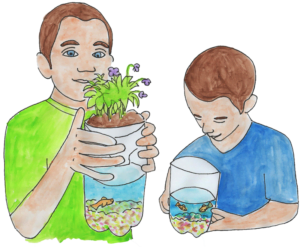
For a great introduction to plants make a poster board showing what a plant needs to grow and then plant a terrarium containing all the ecosystem necessary for plant growth. You need: potting soil one or two small plants a … Continue reading
Ants
Ants are an easy example of insect life to find just about anywhere. Take a jar and shovel and go flip over a few logs or look near the sidewalk. Dribble a bit of fruit juice on the sidewalk a … Continue reading
Why Do Leaves Change Color in the Fall?
I probably shouldn’t be writing this in the spring, eh? But it’s such a cool experiment that I just couldn’t wait! In autumn we watch leaves turn from green to yellow, orange, and red. . . why? Try this experiment: … Continue reading
Marble Roller Coasters and Physics
For a great physics lesson, have kids create a marble roller coaster. You need pipe insulation (a few bucks at any home improvement store), duct tape, and marbles. We used about 3 lengths of the pipe insulation and had more … Continue reading
Dissolving Ink Experiment
Try this cool experiment:Get two mason jars and fill one with water and the other with rubbing alcohol. Using a waterproof (permanent) marker, write 2 of the same message – each on a sheet of tough paper (or fabric). Gently … Continue reading
Rabbits
With Easter coming our way I thought we’d all better brush up on our rabbit knowledge. They are much more than just cute, furry little hoppers. Rabbits are mammals. Many people mistakenly think they are rodents, but in fact, they … Continue reading
Soil Horizons
Dirt is what you get under your fingernails. Soil is where plants grow. And the more you know about soil the more you’ll understand that there isn’t any part of this world that isn’t wondrous. Go outside with a shovel and dig a … Continue reading
Idaho Tree Distribution
Ponderosa Pine Certain trees grow in certain places for very good reasons. Try making a species distribution map for Idaho. We’ll choose six common species. There are of course many more, but the map gets complicated enough with just six. … Continue reading
Experiments With Electricity
To perform electricity experiments with kids from 1st through 8th grade you need these materials: electrical wire: a couple of feet from your local hardware store or you can buy the type with alligator clips from a science supplier. If you want enough for … Continue reading
Conductive Materials
Learn about materials that conduct and materials that do not. Gather some items from both categories like, a banana, rubber bands, coins, paper clips, water (you can try distilled and from-the-tap), paper, cloth, aluminum foil, and a small piece of wood. Create a testing apparatus … Continue reading
Creating a Circuit
A circuit allows electricity to flow around an uninterrupted path. There are two basic types of circuits: parallel and series. A series circuit is like the ones in a flashlight, everything is lined up in a straight line one after another. In a parallel circuit the components are next … Continue reading
A Simple Machine Hunt At The Hardware Store
This is an easy no-need-to-plan-ahead expedition. Head over to your local hardware store and challenge the kids to find some simple machines. Simple machines work for us so we don’t have to. Think of a wheelbarrow– its wheel and axle make it … Continue reading
A Simple Introduction To The Scientific Method
The Scientific Method may seem ominous and confusing, but really simply put, it’s just a way of asking a question and then finding an answer to that question. To introduce kids to it for the first time, you’ll definitely want … Continue reading
Asteroid Diversion Schemes
The asteroid Apophis is nearing Earth. It will pass our planet in 2029 and 2036. The Russians want to visit it on it’s first pass in 2029. The Americans disagree, they say it should be visited in 2036. Both countries … Continue reading
Space Pioneers
Robert Goddard The beginnings of rocketry go way back . . . to the Greeks of course. Doesn’t everything go back to the Greeks? People have been testing methods of propulsion for thousands of years, but it wasn’t until Isaac Newton wrote down … Continue reading
Pneumatic Rockets
Put “pneumatic” on your kid’s spelling list, because this week they’re going to learn about these air driven missiles. A pneumatic rocket is completely impractical for full sized NASA or military rocketry. If they got a big enough air source they could … Continue reading
Going Green Shouldn’t Be Laborious
My son is a cub scout and has been doing a recycling project for the past few months. Our little town does have a recycling program of sorts, but not exactly an EASY one. You can drop off cardboard, newspapers, … Continue reading
Desert Animals Activity
To learn about deserts with kids from K through 8th start by talking about some of the features of a desert. Make a list together of things and conditions you might find in the desert. Older kids should come having read a book or two on … Continue reading
Mad Scientist: Alexis Carrel
Alexis Carrel was a French Scientist who won the Nobel Prize in 1912 for developing methods of suturing veins and arteries. His work and methods have saved thousands of lives and are still very much in use in surgeries today, especially in the area of … Continue reading
Snowflakes
Snowflakes are made up very high in the atmosphere. Way up there in the clouds, water is vapor, not even drops. It’s so tiny that until several molecules can get together the water can’t even freeze into flakes. To get … Continue reading
Solar Energy
Life has always depended on energy, but until just a few hundred years ago that energy was mostly low level, unorganized, passive energy in the form of sunlight which is essential in plant growth. Sunlight is still one of the best sources … Continue reading
Secrets of the Universe in a Candle
Michael Faraday Michael Faraday had very little scientific training and wasn’t particularly good at math, but still he was one of the most brilliant and influential scientists the world has ever known. He had the kind of mind that questioned and sought … Continue reading
Boyle’s Law
This experiment is both chemistry and physics. Sciences sometimes overlap . . . they usually overlap. For example when you study living organisms you have to take into account the chemistry happening inside the body. And the chemistry is in turn governed by the laws … Continue reading
Chemistry: Non-Metals
Non-metals do not conduct electricity, do not conduct heat, are not hard or shiny and are usually a gas in their pure form. The exception is carbon, which does conduct heat and electricity in some forms and which has the ability to … Continue reading
Chemistry: Metals
There are two types of elements in the world: metals and non-metals (at least according to the way humans classify things, which is somewhat arbitrary). Most things in the world fall under the category of metals. Here is a color-coded periodic table … Continue reading
Comets, Meteors, and Asteroids
What’s the difference between a comet and an asteroid or a meteorite? A comet is a big frozen chunk of ice and rock that orbits the sun or another star or zooms madly around space until pulled into the orbit of a star. As they … Continue reading
Eyes
Eyes are some of the most complex structures of the body. They use light and electrical impulses to allow our brains to see our surroundings. Human eyesight is our strongest of the senses. Our eyes have a lens that focuses … Continue reading
History of Ecology
Ecology is the study of earth’s living systems and how they interact. It is not environmentalism, a social and political movement. Ecology is one of the most complex sciences and is very new. As such we are only at the … Continue reading
Wind Detector
Wind speed is measured with anemometers, which spin in the wind. Wind speed can also be measured with the naked eye, a little less accurately, but completely satifactorily for most of us. To make a wind detector: Mark the points … Continue reading
Tigers
A few fun facts on tigers: Tigers are endangered. Wild tigers in Asia (their natural habitat) may soon disappear. Tigers keep their claws sharp by pulling them into a protective sheath (they are retractable) No tigers have identical stripes. Most … Continue reading
The Science of Firecrackers
Fireworks were invented by the Chinese over a thousand years ago. Now we get to see them at all kinds of holiday celebrations throughout the world. There are a lot of different types and they work a little bit differently. … Continue reading
Algae and Pollution
How does pollution affect algae? Before you begin this experiment print out this page on the scientific method and use this process to set up your experiment. Collect a half dozen or more jars and add pond water to each … Continue reading
Levers
Give me a place to stand and with a lever I will move the whole world. -Archimedes A lever is a simple machine with a long pole and a fulcrum. The fulcrum is the point upon which the … Continue reading
Cool Plant Art
I love this idea for plant art. Kathy is an art teacher who posts lots of neat art ideas on her blog. This is one of her latest. It would go perfectly with the plant, garden, and native habitat studies … Continue reading
Making a Native Habitat Garden
Seeing animals and plants in their native habitat is invaluable. Hopefully every child gets to spend some time in nature, away from cities and asphalt. But you can create a native habitat right in your own backyard, perhaps even on … Continue reading
Make A Bouncy Ball
Want to try this cool experiment? Create your own bouncy ball. It’s pretty cool. First, heat 1/2 cup of milk in a little pan on the stove until lumps form. Pour off the liquid really slowly. Now put the leftover … Continue reading
Frogs
First teach some frog facts. Here’s a fun way to do it. Place a dozen or so “lily pads” with frog facts written on them into a large bowl. Call the bowl the pond. Then have the kids take turns … Continue reading
Properties of Matter
Different types of matter have different properties. For example water freezes at 0 deg C or 32 deg F, but oil does not. They have different properties and it is those properties that makes them useful for a variety of … Continue reading
Decoding the Guts of the Computer
I’m very glad that computers work. I like them. They’re like magic boxes as far as I’m concerned. I don’t have the faintest idea how little electric signals, a series of 1′s and 0′s, become what they become. Luckily my curious … Continue reading
Pendulum Waves
A wave is a transference of energy from one point to another. Sometimes it can be seen as a pendulum swinging back and forth, other times it is like a flowing up and down motion, and in still other cases … Continue reading
Earth Day Exploration
Today is earth day. I’m not a fan of pushy environmentalists or the trendy “going green” thing, though I do value our planet and its many natural resources. I do believe we should take care of the planet, though I … Continue reading
Balloon Rockets and Newton
An absolutely fun way to teach Newton’s third law is a balloon rocket. Newton’s Third Law states: For every action there is an equal and opposite reaction. Think of it this way. If you were stadning on roller blades facing … Continue reading
Life Cycle of the Butterfly
I did this activity with young kids, from ages 4 to 7. We made butterflies from coffee filters and paint, then pasted them onto a piece of construction paper with other stages of the life cycle. Here’s how we did … Continue reading
Volcanoes
We did some better-than average activities this week relating to volcanoes and I wanted to share. First there’s the traditional baking soda and vinegar “eruption”, which though certainly not a real eruption, is fun and memorable. Then we made model volcanoes out … Continue reading
Earthquakes
With recent major quakes in Haiti and Chili, one off Japan and many more, you may be interested in helping your kids learn more. Below I give a link to a website that shows all the major quakes of 5.0 and … Continue reading
Parts of a Flower
A tissue paper flower plus. You can use this activity to teach about the parts of a flower. It could easily be used for elementary or high school depending on how many parts you expect the kids to memorize. Materials: … Continue reading
Up Periscope!
My two older boys, ages 12 and 11, and I made this periscope. It could be used in connection with learning about WWI, where they used periscopes to see over the edge of the trenches and in U-boats, while learning … Continue reading
Reversible Reactions
Most reactions once done are done. You can’t take apart a cake you baked and get back out the flour, the eggs, the oil, the sugar, the baking powder and so on. But some reactions are reversible. You can change … Continue reading
The Scientific Method
Scientists use the scientific method to learn and study the world around them. It’s based on asking questions and trying to come up with logical answers through experimenting. Scientists start by making observations so they form a hypothesis (a big … Continue reading
Energy Conversion
Energy conversion is energy changing from one form to another. Like when the electrical energy in the wires to your house changes to light and heat in your light bulb when you flip the switch. Sunlight changes to energy for … Continue reading
Physics: Friction
Friction is the slowing down of a moving object because it is touching another object. Newton said that objects in motion tend to stay in motion and they do. In a vacuum, or in a place with nothing, if an … Continue reading
Physics: Inertia
Inertia is Newton’s first law. It states that an object in motion tends to stay in motion and an object at rest tends to stay at rest. To demonstrate inertia try this experiment. Get a wheeled toy, like a car … Continue reading
Climate
Climate refers to all the factors that make up the weather of a particular place on earth. It includes, rain fall, temperature, wind, storms, and seasonal changes. There are four major climates on earth: Arctic, temperate, tropical, and desert. There … Continue reading
Physics: Forces
Forces are the effects of objects acting on one another. This might be a breeze stirring a leaf or a jet engine strongly pushing on the air to create a forward thrust. Brainstorm as many different things that forces can … Continue reading
Solar System Model
Make a solar system model out of a kit or foam balls from a craft store. Get a bunch of books from the library and let the kids learn what color to paint each planet. My kids made sure to … Continue reading
Health For Young Kids
Most of the things taught in health class in elementary schools is basic stuff you teach kids during the course of family life. Things like brushing teeth, washing hands, using common sense safety measures, eating balanced healthy meals and so … Continue reading
The Science of Sledding
The top of the hill. Anticipation. The ride down. Stimulation and Trepidation. The bottom of the hill. Satisfaction. These three stages, the top, the ride down, and the bottom, are examples of energy in action. At the top you have … Continue reading
Bending Turkey Bones Experiment
Don’t throw away all your turkey bones after dinner! Save a few to try this cool experiment. (It also works with chicken bones for anytime of year.) Gather a couple of pint jars (with lids), and some vinegar. 1. First, … Continue reading
Printable Magnet Unit Book
Click here for a printable unit workbook on magnets for elementary aged kids. It includes some of the magnet projects and experiments from other posts and also some new activity ideas and information. Pick and choose what you want to … Continue reading
Oxidation and Reduction
Oxidation originally meant that oxygen atoms were added to an element or compound, but since then scientists have expanded the definition. Now oxidation refers to any time a negative charge is taken from a molecule. Reduction is the opposite of … Continue reading
Gears, Motors, and Simple Engines
In science we’ve been doing a unit about motors and simple engines. It can be a big concept to tackle with kids, but it’s also so fun that they’re willing to get right in and learn it. We went to … Continue reading
Plant Survey
Real botanists out in the field do plant surveys like this one. The purpose is to find out how many of a particular species is present in a particular place or to discover the distribution and populations of many plants … Continue reading
Backpack Plant Press
Pressing plants is useful for making collections. You can keep the plant leaves, dried out and flattened in a notebook or file. Here’s how to make your own plant press. Cut two pieces of wood so they each measure 5″ … Continue reading
Autumn
Here are some ideas of activities you can do based around autumn time. Draw a picture of what it looks like outside at your house right now. Talk about how it’s different from other seasons and what stays the same. … Continue reading
More Magnetism
Here is an earlier post with more on magnets from our website. Make Your Own Electromagnet:Electromagnets are magnets that use flowing electrons to create a magnetic field. Flowing electrons means electricity. You need: Wire Strippers A long iron nail, the … Continue reading
Magnetism
Magnetism is mysterious and cool. Kids love playing with magnets so these activities should get their attention. First explain what magnetism is. This is tougher than it sounds. Most definitions you read on Magnets and magnetism say something like: A … Continue reading
Crazy Galileo
A long long long time ago a scientist named Galileo declared that without air resistance any two objects would fall at the same rate. People laughed at Galileo for that, among other things. Imagine a feather and a hammer. Which … Continue reading
Is There Zero Gravity in Space?
It seems obvious. Astronauts float around in their space ships up there so there must not be any gravity, right? Not so fast. Gravity is the force between any two objects that have mass. There is mass in space (you, … Continue reading
Sweet Tooth Decay
My kids have dentist appointments coming up and I already feel nervous. No matter how many times I tell them how important it is to brush their teeth well, it doesn’t seem to sink in. I exhaust myself going over … Continue reading
Roller Coasters
Roller coasters are fun physics in action and you can build your own at home. No, not a real, thriller roller coaster, but a coaster with BBs or marbles as the “cars”. Get flexible rubber tubing and BBs or marbles. … Continue reading
Non-Newtonian Fluid
Studying changes of state with kids is really fun and interesting because there are so many simple experiments that can demonstrate the concepts of matter changing from solids to liquids to gases. If your kids are really curious though, introduce … Continue reading
The Chemistry of Water
A water molecule, is made of three atoms, two hydrogen’s and an oxygen. Water has some unique characteristics that make it vital for life. The hydrogen’s carry a positive charge and the oxygen a negative charge, which causes the different … Continue reading
Rockets and the Laws of Newton
Launching a model rocket . . . fun, fun, fun! We made this one from a kit. you can buy one in the toy section of most discount stores or at a hobby shop. It takes some skill to put … Continue reading
The Periodic Table
Making the periodic table of the elements fun. Hmmm . . . that’s a tough one. Start with a period table placemat that has photos of the actual chemicals on it. (Check out the Elementeo game on this site as … Continue reading